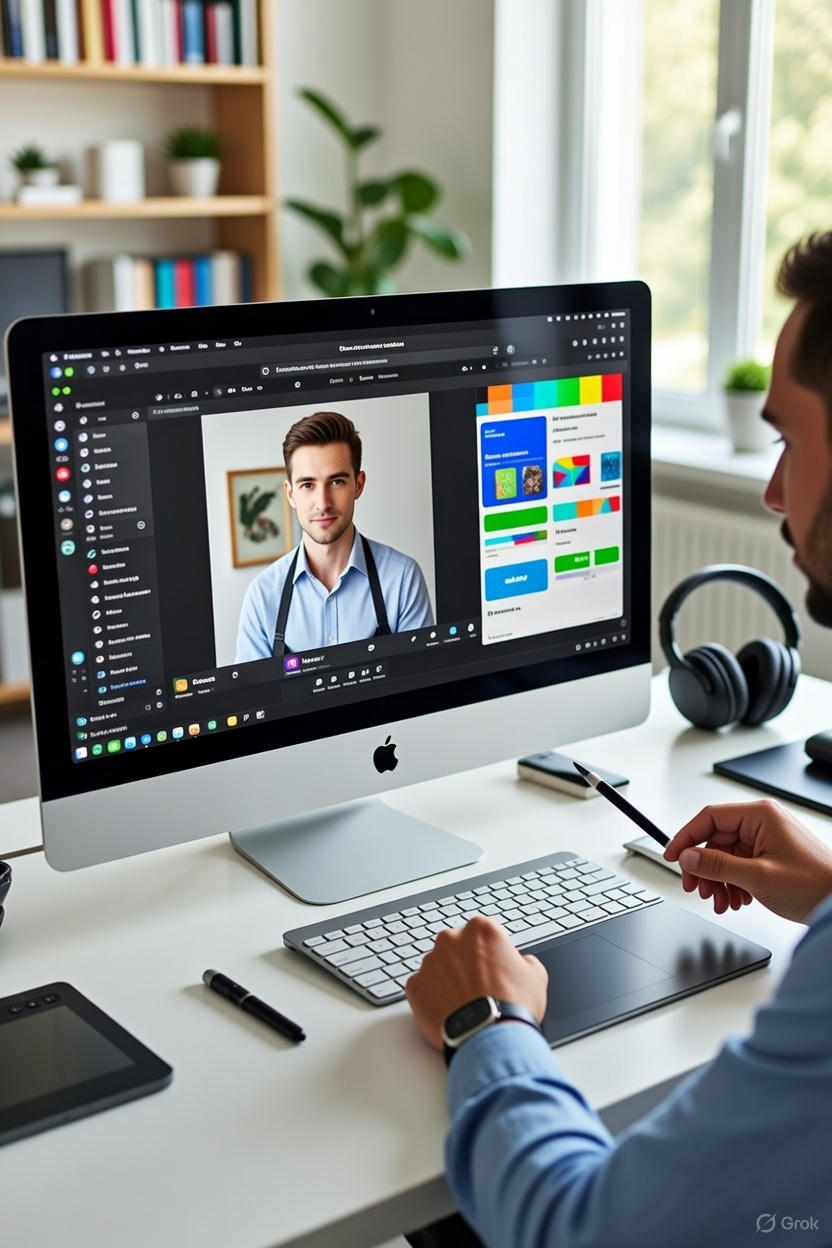
By Ben Aristo
I remember back in 2015, if a student told me they were considering an “online art degree,” I’d probably have choked on my coffee. At the time, the tech was clunky, the curriculum was often a joke, and employers looked at those degrees like they were printed off the back of a cereal box.
But fast forward to 2025? Everything has shifted. Between VR-integrated critique rooms and the sheer explosion of the digital creator economy, the question isn’t “Are online art schools real?” anymore. It’s “Is this specific online program going to get me the career I actually want?”
As an advisor who has seen the “inside” of both the ivy-covered brick-and-mortar campuses and the sleek, browser-based academies, I’ve got some thoughts. If you’re hanging out on ArtSchoolsLists.com trying to decide if you can really learn to paint—or design a video game—from your bedroom, let’s break down the reality of the virtual studio.
1. The Recognition Gap: Do Employers Actually Care?
This is the big one. You don’t want to drop $40k on a degree only to have a hiring manager at a top agency slide your resume into the “No” pile because of the school’s delivery format.
Here is the 2025 update: Most employers don’t care about the “where,” they care about the “what.” In fields like Graphic Design, UI/UX, and 2D Animation, hiring managers rarely even look at your physical diploma. They look at your portfolio. If your work is world-class, they won’t care if you learned it at Yale or in your pajamas at Academy of Art University.
However, there is a caveat. If you’re aiming for the “Fine Art” gallery world or academic teaching roles, the prestige of the institution still carries weight. In those circles, a degree from an online-only, unaccredited shop might raise eyebrows. But if you’re getting a degree from a recognized institution like SCAD (Savannah College of Art and Design) that happens to be online? You’re gold.
2. Accreditation: The Only “Safety Net” That Matters
I tell all my students: If the school isn’t accredited, you aren’t a student; you’re a customer. Accreditation is the stamp of approval from an external body that says, “Yes, this school actually teaches what it says it does.” In the US, look for regional accreditation or specific art-world nods like NASAD (National Association of Schools of Art and Design).
Why does this matter?
- Financial Aid: You can’t get federal grants or loans for unaccredited schools.
- Transfer Credits: Try moving from an unaccredited online school to a traditional Master’s program. They’ll laugh at your transcript.
- Employer Trust: Large corporations often have automated HR filters that check for accreditation status. Don’t let your hard work get filtered out.
3. The Cost Comparison: Is It Actually Cheaper?
You’d think a school without a physical campus would be a bargain, right? Well, yes and no.
On average, a year of online art college in 2025 costs about $12,000 to $18,000, compared to the $35,000+ you’d pay for a private on-campus experience. But you have to look at the “hidden” savings:
- No Room and Board: You save roughly $14,000 a year just by living where you already are.
- No Commute: Gas, parking, and public transit add up.
- Flexible Work: About 45% of online art students work full-time while they study. You can’t easily pull 40 hours a week at a job when you’re stuck in a 9 AM color theory lecture on campus.
However, some prestigious schools charge the exact same tuition for online and on-campus students. They argue you’re paying for the faculty and the brand, not the bricks. Always check the fine print on ArtSchoolsLists.com/costs before you sign.
4. The Virtual Critique: How Do You Learn Art Through a Screen?
The biggest hurdle for online art is the “Crit.” In a traditional school, you stand around a table while a professor tears your work apart (kindly, usually).
In 2025, the best online schools have gamified this. We’re talking about:
- Live Video Critiques: Zoom sessions where you can see the professor’s brushstrokes or digital edits in real-time.
- VR Studios: Some advanced programs now use headsets so you can “walk” around a 3D sculpture your classmate made.
- Asynchronous Feedback: You upload a high-res file, and your instructor records a video overlay of them “red-lining” your work.
Is it the same as being in a room with the smell of turpentine? No. But for many digital-first disciplines, it’s actually better. Learning digital painting on the same screen you’ll eventually work on professionally just makes sense.
5. Pros and Cons: A Ben Aristo Reality Check
I like to be blunt with my clients. Online school isn’t for everyone.
The Perks (Why people love it)
- Pace: You don’t have to wait for the “slowest” kid in the class to catch up.
- Global Network: You might be in a crit group with someone from Tokyo, London, and Lagos. That’s a global network day one.
- Focus: No campus distractions. No frat parties (unless you host one in your kitchen).
The Pitfalls (The stuff they don’t tell you in the brochure)
- Isolation: Art is a social sport. You have to work twice as hard to build relationships online.
- Discipline: If you’re the type of person who needs someone watching over your shoulder to get work done, online school is going to be a disaster for you.
- Lack of Equipment: If you’re a sculptor or a printmaker, you need a kiln or a press. Unless you have $10,000 to build a home studio, you might need a physical campus.
6. Top 5 Online Art Schools to Watch in 2025
If you’re looking for names that actually hold weight, these are the heavy hitters I usually point my students toward:
- SCAD (Savannah College of Art and Design): The gold standard for online design and digital media.
- Academy of Art University: Massive range of programs, very veteran-friendly, and highly specialized.
- Arizona State University (ASU) Online: Great for Art History and Museum Studies with a “big university” name.
- Full Sail University: If you want to get into Game Design or Digital Animation, their accelerated online tracks are intense but effective.
- The New School (Parsons): Prestigious, high-end, and starting to offer more robust online certificate and degree paths.
7. The “Mastery” Alternative: Degree vs. Certificate
Here is a 2025 “Ben Aristo” insider tip: You might not actually need a degree.
If you just want to get a job at a game studio or a design firm, intensive online “Mastery Programs” like Schoolism or CGMA can be worth more than a four-year degree from a mediocre college. These programs aren’t “accredited” in the traditional sense, but they are taught by people currently working at Disney, Pixar, and Nike.
In the digital arts, your portfolio is your degree. If a certificate from an industry-led program gets your portfolio to a professional level in 18 months for 1/10th the cost, that’s a win.
8. Questions to Ask Before You Hit “Enroll”
Don’t just get seduced by a pretty website. Ask the admissions rep these three things:
- “Who is teaching my specific classes?” (You want working professionals, not just career academics).
- “What does your alumni network look like for online students?” (Do they get the same career placement help as on-campus kids?)
- “Can I see a sample of a ‘Virtual Critique’ session?” (If it’s just a text comment box, run away).
9. Is It Worth It? My Final Verdict
In 2025, online art schools are absolutely “worth it” IF you are a self-motivated, digitally-leaning creative who values flexibility over the “college experience.”
If you want to be a traditional oil painter or a large-scale metal sculptor, go to a physical school. You need the space, the tools, and the physical presence of a master.
But if you’re looking at Graphic Design, Illustration, Animation, or Game Art? An online degree is a smart, lean, and modern way to launch your career without drowning in six-figure debt.
The walls of the classroom are gone. Your studio is wherever you plug in your laptop. Just make sure you’re choosing a program that builds your skills, not just your resume.
Stay curious, stay disciplined, and for heaven’s sake, back up your digital files.
— Ben Aristo
FAQ: The Online Art School “Stupid Questions” (That aren’t actually stupid)
Q: Will my diploma say “Online” on it? A: Usually, no. Most universities like ASU or SCAD grant the same degree regardless of how you took the classes. A “BFA in Illustration” is a BFA in Illustration.
Q: Can I get an art scholarship for an online program? A: Yes! Many schools offer “Achievement” or “Portfolio” scholarships specifically for their online cohorts. We keep a running list of these over at ArtSchoolsLists.com/scholarships.
Q: How do I handle art supplies? A: Most online schools give you a “kit list.” You’ll have to buy your own brushes, tablets, or software. Budget about $500–$1,500 a year for this—still cheaper than campus meal plans!
Q: Is it harder to get a job? A: Only if your portfolio is weak. If anything, online grads are often seen as more disciplined because they had to manage their own time for four years.